Results are out. Relatives are calling. Someone's cousin got into a "good college" and now everyone at the dinner table has an opinion about your future. If you're reading this, chances are you're tired of hearing "Bas graduation kar lo, baad mein dekhenge" (just do graduation, we'll see later).
Here's the thing. "Baad mein dekhenge" is how a lot of people end up 22, holding a B.Com, and wondering why nobody's hiring them. If what you actually want is a job, and preferably some money in your pocket soon, you need to plan for that now, not after three years.
This post is for people who want to start working. Not people who want to avoid studying, there's a difference. Let's go through the realistic options.
First, be honest about what you want
Before picking any course, answer three questions on paper. Not in your head. On paper.
Do you need to start earning within a year? Are you more comfortable doing things with your hands and in real settings, or reading and writing? And is anyone in your family expecting a government job attempt, because that changes your timeline a lot.
There's no wrong answer. But if your honest answer to the first question is yes, a regular three-year degree on its own probably isn't your best plan.
The usual options after 12th, compared honestly
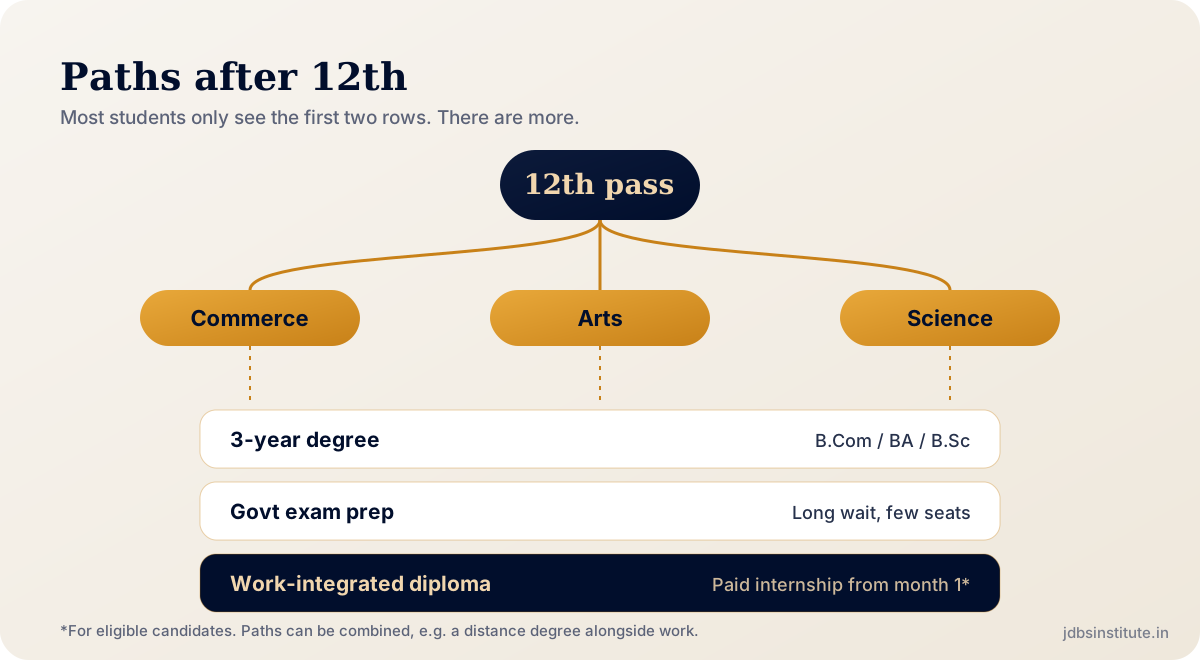
A regular degree (B.Com, BA, BSc)
Fine if you want it, or if a future exam or job requires it. The catch is that most degree programs don't teach you how to work. You'll finish with knowledge and very little proof that you can apply it. In Kanpur, the B.Com and BA crowds are huge, so you'll be competing with a lot of people holding the same paper.
Professional degrees (B.Tech, BBA, etc.)
Useful, often expensive, and still light on real work unless the college has strong industry ties. Worth it if you're sure of the field and can afford it.
Short skill courses
Computer courses, accounting software, spoken English. They help, but on their own they rarely get you hired. Employers still ask about experience.
Diplomas and work-integrated programs
This is where learning and working happen together. You get trained, and you spend real time inside a company while doing it. It's the option most people don't hear about from relatives, mainly because it wasn't common when they were 18.
We explained how this model works in detail in our post on learn while you earn and work-integrated learning in Kanpur, so we won't repeat all of it here.
Why experience matters more than which course you pick
Picture two students. Both finished 12th in the same year. One did a three-year degree and nothing else. The other did a diploma with paid practical training and has two years of real work behind them by 20.
Now put them in the same interview at a manufacturing company in Dada Nagar. Who do you think the HR manager is more interested in? It's not even close. The second one already knows what a work shift feels like, how to report to someone and how to fix a mistake without panicking.
That's not a knock on degrees. It's just how hiring works. Experience is the thing everyone asks for and almost nobody gives freshers.
Courses after 12th that lead to jobs: what to look for
When you're comparing institutes (including us), ask these questions directly.
- Will I work in a real company during the course, or only after it?
- Is the internship paid, and from when?
- Which companies do you actually work with?
- Do you help with resume building and interview prep, or just hand over a certificate?
- If you offer any job guarantee, what are the exact conditions?
If an institute gets vague on any of these, that tells you something.
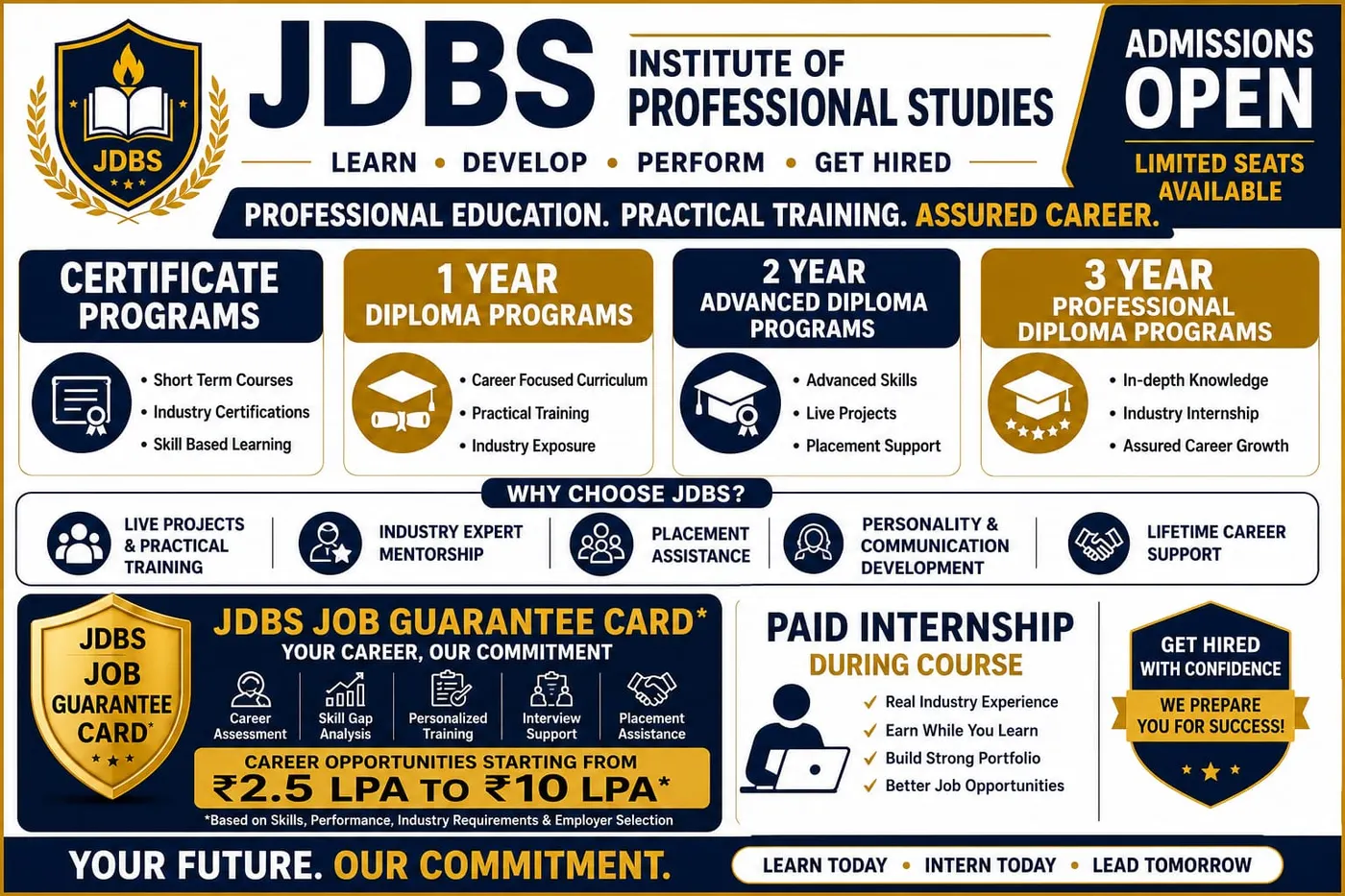
At JDBS, eligible candidates start paid practical training from the first month. Companies we work with include Havells, Astral Pipes, Supreme, Lohia Group, Superhouse Group and others around Kanpur. Every program includes resume building, interview preparation and placement assistance, and eligible candidates get a Job Guarantee Card* (conditions apply, based on completion, attendance, performance and conduct).
How long should your first course be?
Depends on how much time and patience you have. We offer programs from 3 months (Fast-Track Skill Development) to 6 months, 9 months, and 1, 2 or 3 year diplomas. Shorter programs get you started quickly. Longer ones go deeper and give you more work experience by the end.
A quick rule of thumb we give students: if you're not sure what field you like, start shorter and decide later. If you already know, a 1 or 2 year diploma usually gives you the strongest resume.
What about parents who want a "proper" degree?
Very common. Very understandable. Many parents worry that anything other than a degree looks like a step down.
Two things help. First, a diploma doesn't stop you from doing a degree later or even alongside. Second, the stipend changes minds. When parents see their child earning during training, and see many students recover a good part of their course cost through it, the conversation tends to get a lot calmer. We're happy to talk to parents directly, by the way. Bring them along.
A simple plan for the next 30 days
If you're feeling stuck, here's something concrete. In the first week, write down three jobs you'd genuinely like to do and look up real listings for them in Kanpur. In the second week, note what those listings ask for: skills, software, experience, qualifications. In the third week, visit two or three institutes (us included) and ask the questions from the list above. In the fourth week, sit with your family and decide.
Thirty days is enough to make a proper decision. It's also short enough that you won't lose a whole year drifting, which is what happens to a surprising number of people who wait for "the right time".
Your next step
You don't have to decide your whole career this week. You just have to pick a direction that leads somewhere real. If you'd like help thinking it through, drop by our office in Govind Nagar, read how JDBS works, or apply online and we'll call you back. No pressure, just an honest conversation about what fits you.