This might be the most argued-about question in Indian households after "what's for dinner". Diploma or degree? Uncles have strong opinions. So do neighbours. Most of them made this choice in a very different job market.
We'll give you our honest take. And yes, we run diploma programs, so read this with that in mind. But we also tell students every week when a degree is the right call, because sending someone down the wrong path doesn't help anybody.
The short answer
If your goal is to get hired quickly in a practical role, a diploma with real work experience usually gets you there faster. If your goal needs a degree on paper (many government jobs, teaching, law, research), then you need a degree, full stop.
Most people fall somewhere in between. That's where it gets interesting.
Time: how long until you're employable?
A regular degree takes three years, sometimes four. A lot of that time, for a lot of students, is spent in lectures that have little to do with any job they'll do later.
A diploma is usually one to three years, and our shorter programs start at 3 months. More importantly, in a work-integrated diploma, you're becoming employable from the start, not at the end. Eligible JDBS students begin paid practical training in the first month. So the real comparison isn't "1 year vs 3 years". It's "employable during the course vs employable after it, maybe".
Cost: what you spend and what you get back
Degrees vary wildly in cost. A private B.Tech or BBA can run into many lakhs. A government college B.Com is much cheaper but often comes with little practical training.
Diplomas are generally shorter, so the total spend is lower. In our model there's another factor: the stipend. Many of our students recover a significant portion of their course cost through what they earn during paid practical training, and some recover all of it. We never promise that, because it depends on the student and the placement. But it's common enough that parents ask about it on day one.
Skills: what employers actually test you on
Here's where things get uncomfortable for degree-only students.
Employers in Kanpur's industrial belts, from Panki to Dada Nagar, rarely ask about your third-semester marks. They ask whether you've used a particular system, whether you can handle a team, whether you can write a clear report. Most of that comes from work, not exams.
A good diploma is built around exactly those skills. Ours include professional grooming, resume building and interview preparation alongside the technical training. Picture a B.Com graduate and a diploma student sitting in the same interview. The diploma student says "I worked in the dispatch department for eight months and handled daily stock reports." The graduate says "I studied cost accounting." Who would you hire?
Experience: the deciding factor
We've said this in nearly every post so far, and we'll keep saying it. Experience is the thing freshers lack, and it's the thing employers want most.
That's why we built everything around work-integrated learning. If you want the full breakdown, read our explainer on how learn while you earn works in Kanpur. The short version: by the end of a JDBS diploma, you've already worked in a real company, and that changes how every interview goes.
When a degree is the better choice
We'd be lying if we said diplomas win every time. Choose a degree if:
- you're aiming for a government job or exam that requires graduation
- you want to go into teaching, law, medicine or research
- your family can support you for three or more years and you genuinely enjoy academic study
- the specific field you love only hires graduates
Honestly, not everyone needs a diploma. Some people thrive in college and should be there.
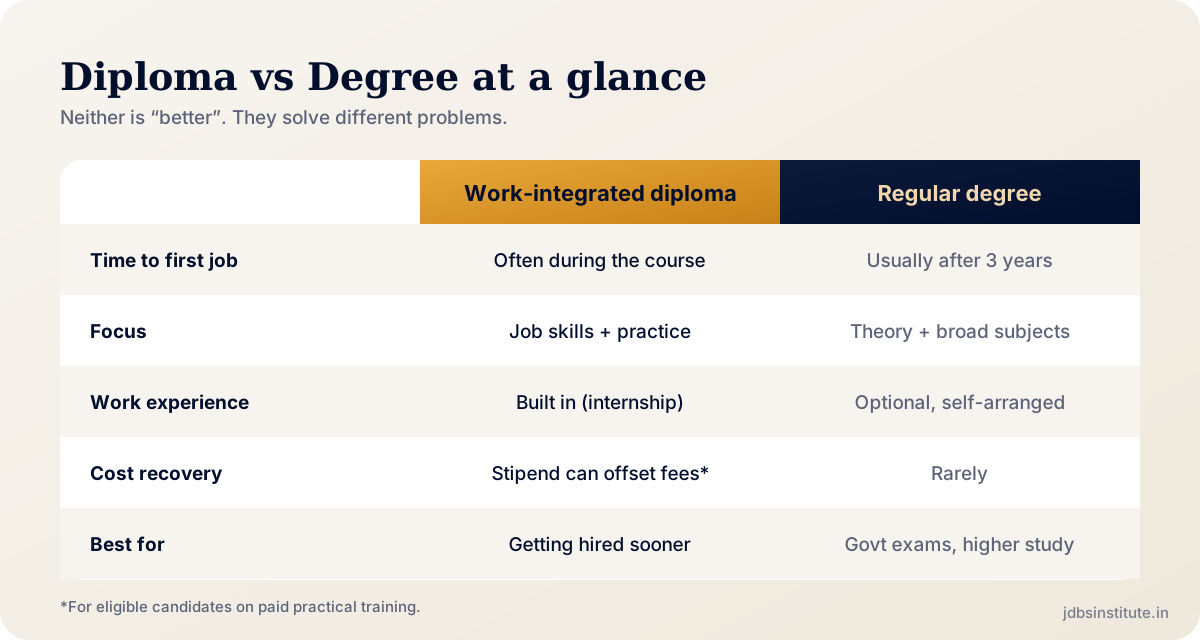
A quick side-by-side
| Regular degree | Work-integrated diploma | |
|---|---|---|
| Typical length | 3 to 4 years | 3 months to 3 years |
| Real work during the course | Rare | Built in, from month one for eligible students |
| Earning while studying | Usually no | Monthly stipend during paid practical training |
| Needed for many government posts | Yes | No |
| Experience on your resume at the end | Little or none | Months or years |
The table isn't the whole story. It just shows where each one is strong.
Why not both?
This is what a lot of our students end up doing. Start with a diploma, get working, earn a stipend, and do a degree through distance mode at the same time or a bit later. You end up with the paper and the experience. It's harder, and you'll be busy. But by 22 you'd have both, and most of your batchmates would have only one.
How to decide
Ask yourself: what's the first job I want, and what does that job ask for? Look at real job listings in Kanpur for that role. If they ask for "graduate", plan for a degree, maybe alongside a diploma. If they ask for "experience" and "skills" (most do), a work-integrated diploma will probably get you there faster.
Our programs include Certificate Programs, a 1 Year Diploma, a 2 Years Advanced Diploma and a 3 Years Professional Diploma, all with paid practical training* and placement assistance. Eligible students also get a Job Guarantee Card* (conditions apply). The details are on our About page, or you can read what to do after 12th if you want a job if you're still at that stage.
What happens five years later
People sometimes worry that a diploma "caps" how far you can go. In our experience, what limits careers is usually a lack of skills, confidence or opportunities, not the name of the qualification. Someone who starts working at 19, keeps learning, and adds a degree along the way often ends up ahead by 25. Not always. But often.
Talk it through with us
If you're stuck between the two, come and talk to us at our Govind Nagar office or call 7081107037. We'll look at your goals, not just our programs. And if a diploma makes sense, you can apply here whenever you're ready.