
Every week someone walks into our Govind Nagar office, sits down, and asks some version of the same thing: "Sir, which one is best, 3 months, 6 months or 1 year?"
And every week we give the slightly annoying answer: it depends. But it doesn't depend on mysterious things. It depends on three or four questions you can answer about yourself in ten minutes. So let's go through them properly, the way we would if you were sitting across the table from us.
Why course length matters more than people think
Most students pick a duration based on one thing, which is how soon they want it to be over. Fair enough. Nobody wants to spend longer than they need to.
But the length of a course decides how deep you go, how much real work experience you collect, and what kind of role you can confidently apply for at the end. A three-month program and a one-year program aren't the same product in different sizes. They're built for different people.
At JDBS we run six durations, and the names tell you what each one is meant to do:
| Duration | Program | Built for |
|---|---|---|
| 3 Months | Fast-Track Skill Development | Adding one job-ready skill quickly |
| 6 Months | Professional Skill Enhancement | Building a solid skill set plus work exposure |
| 9 Months | Advanced Career Development | Going deeper before stepping into a role |
| 1 Year | Comprehensive Industry-Integrated | A full career foundation with sustained work experience |
| 2 Years | Advanced Professional Certification | Advanced skills and live projects |
| 3 Years | Complete Career & Industry Excellence | The long game, with in-depth knowledge and growth |
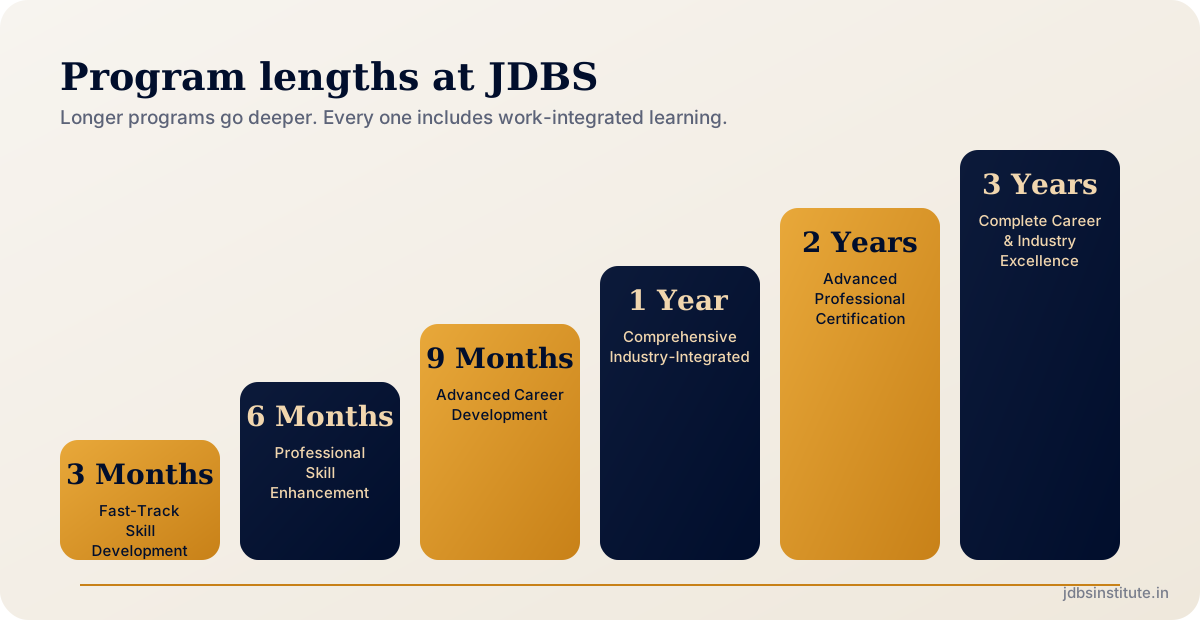
This post focuses on the first rung decision most people face: short, medium or a full year.
When a 3-month course makes sense
Three months is short. You can't become an expert in anything in twelve weeks, and anyone who tells you otherwise is selling something.
What you can do in three months is pick up one clear, useful skill and start using it at work. That works brilliantly for a specific kind of person.
Say you've finished your B.Com from a Kanpur college. You know the theory, you've got the degree, but every job listing asks for practical stuff you never touched in class. A fast-track program fills that gap. You're not starting from scratch. You're adding the missing piece.
It also suits people already working who want to move sideways, maybe from a sales counter job into a back-office role. They don't have a year to spare. Three months is a realistic commitment.
Where it doesn't fit so well is when you're fresh out of 12th with no degree and no work history. Three months will get you moving, but it usually won't get you all the way. In those cases we often suggest treating it as a trial run.
When a 6-month course is the sweet spot
Honestly, six months is where a lot of our students land, and for good reason.
It's long enough to go beyond one skill. You get a proper set of abilities, you get time in a real workplace through paid practical training, and you get grooming and interview prep that actually sinks in. It's short enough that families don't feel they're signing up for another degree.
Six months suits the student who's a bit unsure. Maybe you're doing a regular BA or B.Com alongside, or you've taken a gap after 12th and the family is (gently or not so gently) asking about plans. Six months shows real progress without locking you in.
If you've read our piece on what to do after 12th if you want a job, you'll know we're big on getting work experience early. Six months gives you enough time at a company that it starts to look meaningful on a resume.
When a 1-year course is worth the wait
A year sounds like a lot when you're nineteen. It isn't, really. It's the same time you'd spend on one year of a three-year degree, except here you spend it learning and working at the same time.
The 1-year Comprehensive Industry-Integrated program is designed for people who want a full foundation. You get a career-focused curriculum, practical training and sustained industry exposure. Through our work-integrated learning model, eligible students start paid practical training from the first month, so by the end of the year you're not a fresher in the usual sense. You've been working for most of it.

There's a quieter benefit too. Employers notice consistency. Someone who has shown up at a workplace for a year, handled responsibility, and stuck with it tells a hiring manager more than any certificate does.
The 1-year route makes most sense if you're starting fresh after 12th, if you don't plan to do a regular degree, or if you're clear about wanting to build a career rather than just add a skill.
Four questions to ask yourself before choosing
Forget which course sounds impressive. Answer these honestly instead.
- What do you already have? A degree and some basics point to shorter. Starting from 12th points to longer.
- How soon do you need to earn? Our programs include paid practical training for eligible candidates from month one, so you're not waiting to earn anything. But if you need a full-time job quickly, a focused short program might be the faster bridge.
- What role do you want? Entry roles in stores, accounts or admin can be reached with shorter programs. Roles with more responsibility usually need more depth.
- Are you doing anything else alongside? A regular degree plus a long program can be a lot. Be realistic about your week.
Write your answers down. Show them to a parent. You'll find the choice gets a lot clearer.
A word on cost and value
People often compare courses by fee alone. That's understandable, but it misses something.
With a paid internship built in, many students recover a good part of their course cost through the stipend they earn while training. Some recover all of it. So a longer program doesn't automatically mean you pay more out of pocket in the end. It depends on your performance, your placement and how consistently you show up. We'll explain how it works in your specific case before you commit to anything, and you can read more on our About page.
Our honest recommendation
If you have a degree and need one skill, go short. If you're unsure and want to test the waters with real work, go for six months. If you're fresh out of 12th and want a career rather than a stopgap, give the one-year program serious thought.
And if you still can't decide, that's normal. Come and talk to us. We'd rather spend half an hour helping you pick the right one than enrol you in the wrong one. You can start an application online, or call us on 7081107037 and we'll set up a proper conversation.