Every year around results season, our office in Govind Nagar gets the same visitor. Sometimes it's a student, sometimes it's a worried father holding a folder of marksheets. The question is almost always some version of this: "Beta ne graduation toh kar liya, ab job kyun nahi mil rahi?" (He finished his degree, so why isn't he getting a job?)
We've heard it enough times to know the answer usually isn't a lack of intelligence or effort. It's a lack of experience. Companies keep asking for it, and freshers have no way to get it. That's the gap work-integrated learning is built to close, and it's the reason JDBS Institute exists. Here's how it works, without the brochure language.
What "learn while you earn" actually means
The idea is simple. Instead of studying for three years and only then looking for your first workplace, you start working in a real company while you're still enrolled. The classroom part and the work part run together, and each one feeds the other.
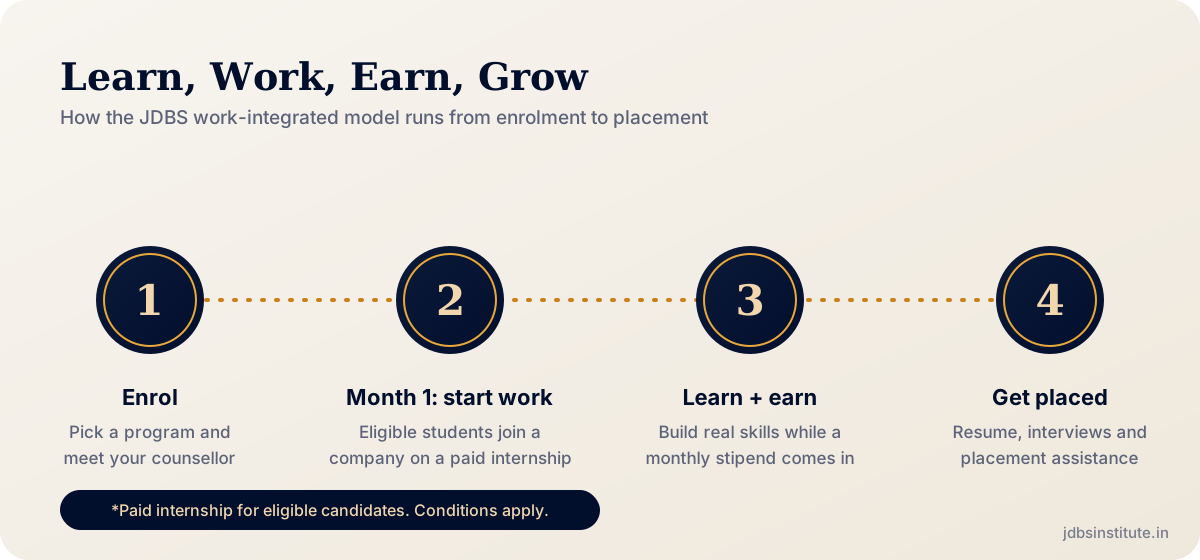
At JDBS, eligible candidates are placed in companies for paid practical training (a paid internship) from the first month of the program. Not the final semester. The first month. You learn something in a session on Monday, and by Thursday you might be watching it happen on a shop floor in Panki or in an office near Mall Road.
We sum it up in four words: Learn, Work, Earn, Grow. It sounds like a slogan, and fine, it is one. But it's also literally the order things happen in.
Why classroom-only learning leaves freshers stuck
Kanpur has no shortage of graduates. Walk past any coaching lane in Kakadeo and you'll see hundreds of them. The problem is that a degree tells an employer you can pass exams. It doesn't tell them you can show up on time for six months, handle a supervisor who's in a bad mood, write a proper email, or learn a new software in a week.
So the fresher applies, gets asked "Any experience?", says no, and doesn't get the job that would have given them experience. It's a loop. Honestly, it's a bit absurd, and almost everyone we counsel has been caught in it at least once.
Work-integrated learning breaks the loop from the inside. By the time you finish your program, you're not a fresher in the usual sense. You have months (or years, depending on the program) of actual work behind you, plus people who've seen you do it.
How a paid internship from the first month works at JDBS
Here's roughly what the first few weeks look like for an eligible student.
Week one: getting you ready to be sent anywhere
Nobody gets dropped into a company cold. We start with professional grooming: how to speak to seniors, basic workplace habits, how to introduce yourself without mumbling. It sounds small. It isn't. Half of first-week mistakes are about behaviour, not skill.
Month one: placement in a company
Eligible candidates then start paid practical training with a company. Companies we work with include names like Havells, Astral Pipes, Supreme, Lohia Group, Superhouse Group, Rimjhim Ispat and Kanpur Plastipack, among others. The exact placement depends on your program, your interests and what openings exist at that time.
The rest of the course: learning on two tracks
You keep attending your training sessions while you work. The useful thing is that your questions get better. Instead of memorising a definition of inventory management, you're asking why your supervisor counts stock on Fridays and not Mondays. That kind of learning sticks.

What you earn, and how the stipend can offset your fees
Eligible candidates earn a monthly stipend during their practical training. We won't put a fixed number in a blog post, because it genuinely varies by company and role, and anyone quoting you a flat amount before knowing your profile is guessing.
What we can say is this: many of our students recover a significant part of their course cost through the stipend, and some recover all of it. For a lot of families in Kanpur, that changes the conversation completely. A course stops being an expense you hope pays off later. It starts paying back while it's still running.
There's a less obvious benefit too. Earning your own money at 19 or 20 does something to your confidence. Students who come in quiet often start carrying themselves differently by month three. Parents notice it before we do.
A normal week, once you're settled in
People always ask what this looks like day to day, so here's a rough picture. Say you're on a 1 year diploma and placed with a manufacturing company in Panki. Most of your week is spent at the company, learning the ropes from the people who actually run things. On set days you're back with us for training sessions, doubt clearing and grooming work. Your trainer knows where you're placed, so the examples in class start to match what you're seeing at work.
Some weeks are boring. Some are stressful. Once in a while something goes wrong and you have to stay late to fix it. That's not a flaw in the system. That's what work is like, and learning it at 19 is a lot easier than learning it at 24 in your first "real" job.
Which programs use this model
Every JDBS program is built around work-integrated learning. They differ mainly in depth and duration:
| Program | Best for |
|---|---|
| Certificate Programs | A short, skill-based start with an industry certificate |
| 1 Year Diploma | A career-focused curriculum with practical training and industry exposure |
| 2 Years Advanced Diploma | Advanced skills, live projects and placement support |
| 3 Years Professional Diploma | In-depth knowledge, a longer industry internship and steady career growth |
We also run focused tracks from 3 months (Fast-Track Skill Development) through 6 and 9 months, up to 1, 2 and 3 year programs. All of them include paid practical training or internship*, resume building, interview preparation, placement assistance and a Job Guarantee Card* for eligible candidates (conditions apply, and they're spelled out on our terms page).
You can read more about how we think about all this on our About page.
Who this model suits, and who it doesn't
We'd rather you choose well than choose us.
It suits you if you want to start working soon, you learn better by doing than by reading, your family would be relieved to see some income early, or you've already tried the degree-then-job route and got stuck at "no experience".
It probably isn't right if you're preparing full time for a competitive exam and need every hour for that, or if you're heading towards research or academics where a traditional degree path is the norm. Honestly, not everyone needs a diploma, and we'd tell you that across the table too.
What happens after the program ends
By the end, you'll have a resume with real work on it, people who can vouch for you, and interview practice that wasn't just mock questions. Placement assistance continues through our network, and eligible students can use the Job Guarantee Card*, subject to course completion, attendance, internship performance, conduct and interview participation.
Career opportunities for our students start from ₹2.5 LPA and go up to ₹10 LPA*, depending on skills, performance, industry requirements and the employer's own selection. We put that asterisk there on purpose. Nobody can promise you a salary. What we can do is put you in front of the right people with the right experience.
Some of our students have gone a long way. Vaishnavi Shukla rose to Vice President HR with Hero MotoCorp and Mahindra Group. Riya Srivastava got a job offer at Superhouse Group right here in Kanpur. Aryan Tripathi is a software developer at Dataman Computer Systems. You can see more on our testimonials page.
Come and see it for yourself
If any of this sounds like what you've been looking for, the easiest next step is a conversation. Visit us at 126/55 H Block, Govind Nagar (4th left turn in the HDFC Bank lane), call 7081107037, or start your application online. It takes about two minutes. Bring your questions, and bring your parents too if they have doubts. We're used to both.