Every year around results time, we get the same phone call. A student, sometimes a slightly embarrassed one, says, "Sir, I took Arts. Is there anything for me?"
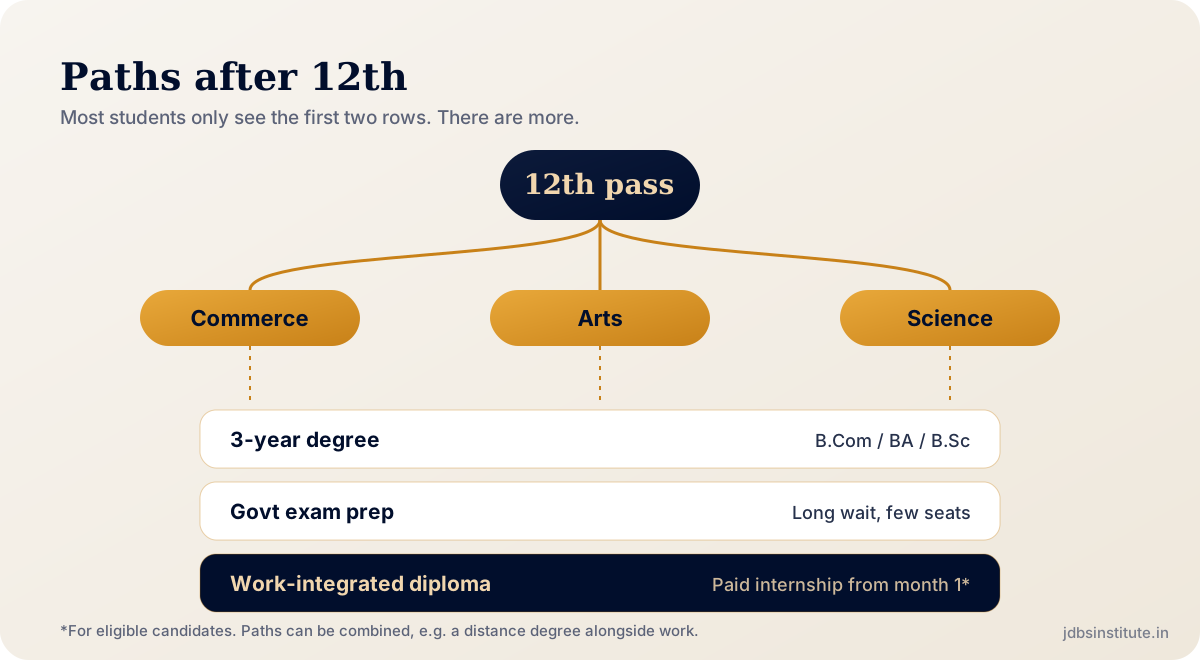
There is. Quite a lot, actually. The problem isn't the stream. The problem is that most Arts students in Kanpur are only ever shown two doors: a BA that drifts along for three years, or government exam coaching that drifts along for even longer. Both can work. Neither is the only option.
This post is for the Arts student who wants a paycheque in the next year or two, not someday. We'll keep it practical.
Why Arts students get overlooked (and why that's unfair)
Somewhere along the way, people decided that Arts was the "leftover" stream. Science for the toppers, Commerce for the business families, Arts for everyone else.
That's nonsense, and employers know it. Think about what an Arts student spends two years doing: reading, writing, arguing a point, understanding people and society. Now think about what a front office executive or an HR assistant does all day. Reading, writing, explaining things, dealing with people. The overlap is huge.
What Arts students usually lack isn't ability. It's proof. They've never been inside an office, never handled a real customer, never sent a work email. Fix that, and the stream on the marksheet stops mattering very much.
Career options after 12th Arts that actually hire
Here's what we see working for Arts students in and around Kanpur. None of these need a science background, and all of them value the skills you already have.
HR assistant or HR executive
Every company with more than a handful of employees needs someone to manage attendance, joining paperwork, leave records and basic recruitment. It's organised, people-heavy work. If you're patient and good at keeping track of things, it suits you. And it can grow: one of our own success stories, Vaishnavi Shukla, went on to become Vice President HR with Hero MotoCorp and Mahindra Group. That's the far end of the road, but the road exists.
Front office and administration
Reception, visitor management, scheduling, coordinating between departments. Factories in Panki and Dada Nagar, hospitals, schools, showrooms, they all need people who can stay calm and look presentable while three things happen at once. This is often the fastest entry point.
Customer support
Phone and chat support, complaint handling, order follow-ups. Hindi plus workable English is a real advantage here, because a lot of customers in UP prefer Hindi. Shifts can be demanding, so be honest with yourself about that.
Sales and marketing
If you can talk to strangers without your voice shaking (or you're willing to practise until it stops), sales pays better than most entry-level work because of incentives. Field sales, showroom sales, B2B sales for industrial products. It's not glamorous at the start. It does teach you more about business than any textbook.
Content and social media
Good at writing? Enjoy making reels? Small businesses across Kanpur need someone to run their Instagram, write product descriptions and reply to messages. Arts students who write cleanly in both Hindi and English have an edge.
Teaching assistant and coaching support
Coaching centres and schools hire assistants for doubt sessions, admin and parent communication. If you're also preparing for exams yourself, this can sit nicely alongside.
An honest word about government exam preparation
We're not going to pretend government jobs aren't attractive. Job security matters, and in a lot of Kanpur families, a sarkari naukri is the dream. Fair enough.
But please be realistic about the odds and the time. Seats are limited, competition is enormous, and preparation can stretch for years. We've met students who are 25, still preparing, with no work experience and growing pressure at home. That's a hard place to be.
Our suggestion? Don't make it all-or-nothing. Keep preparing in the mornings or evenings if you want to, but build some work experience during the day. If the exam clears, wonderful. If it doesn't, you're not starting from zero.
How to pick the right path for you
A quick way to think about it: what do you enjoy doing for two hours without checking your phone?
| If you enjoy... | Look at... |
|---|---|
| Talking to people, solving their problems | Customer support, front office, sales |
| Organising, keeping records tidy | HR assistant, administration |
| Writing, designing posts, storytelling | Content and social media |
| Explaining things to younger students | Teaching assistant, coaching support |
It's not a perfect science. But it's a better starting point than picking whatever your cousin picked.
If you're still weighing up the bigger picture, our earlier piece on what to do after 12th if you want a job, not just a degree goes into the general decision. Commerce friends might find career options after 12th Commerce useful too.
Where a work-integrated program fits
This is where we'll talk about what we do, briefly.
At JDBS Institute, we run programs on a Work-Integrated Learning Model. In plain words: you don't spend a year in a classroom and then go looking for a job. From the first month, eligible students are placed in companies for paid practical training, so you're earning a monthly stipend while you learn.
For an Arts student, this solves the "no proof" problem directly. Six months in, you're not saying "I'm good with people." You're saying "I handled the front desk at a manufacturing company for five months." That's a very different interview.
We offer short certificate programs, a 1-year diploma, a 2-year advanced diploma and a 3-year professional diploma, with durations from 3 months upwards. Every program includes professional grooming, resume building, interview preparation and placement assistance. Eligible candidates also get our Job Guarantee Card*, which comes with conditions around attendance, performance and conduct (conditions apply, and they're spelled out plainly).
You can read more about how the model works on our About page, or see why it matters in our guide to learn-while-you-earn in Kanpur.
A few things to do this month, whatever you choose
Honestly, not everyone needs to join a course tomorrow. Some of you need a few weeks to think. That's fine. But don't spend those weeks only scrolling.
Start practising spoken English for ten minutes a day, even if it's just reading a newspaper aloud. Make a simple one-page resume, even if it's thin. Learn basic computer skills properly: typing speed, MS Word, Excel basics, writing an email. And talk to at least two people who actually work in the field you're curious about. Ask them what a normal Tuesday looks like.
These small things compound. By the time you sit for your first interview, you'll feel much less lost.
You picked Arts. Good. Now pick a direction.
Your stream doesn't decide your salary. What you do in the next 12 to 24 months does a lot more of that.
If you'd like to talk it through, come and see us at our Govind Nagar office, call 7081107037, or start an application online. There's no pressure. We'd rather you leave with a clear plan, even if that plan doesn't include us.