

Search "paid internship course Kanpur" and you'll find no shortage of promises. Banners on Swaroop Nagar walls, WhatsApp forwards, a cousin's friend who "knows someone". Some of these are genuinely good. Some are a certificate printed on nice paper and not much else.
We run a paid internship model ourselves, so yes, we have a stake in this. But we'd honestly rather you pick a good program anywhere than a bad one from anyone. So here's the checklist we'd use if we were 19 and shopping around.
What a real paid internship course looks like
A proper one has three parts that fit together: training (you learn the skill), real work (you use it inside an actual company) and a stipend (you get paid for that work). Take away any one and it's something else.
Training without work is just a course. Work without training is just a low-paid job. And a "paid internship" where you never see a workplace isn't an internship at all.
If you want the full picture of how this model works, our earlier post on learn while you earn in Kanpur walks through it step by step.

Five questions to ask before you pay anything
1. When does the internship actually start?
"After the course" is a very different deal from "in the first month". If the internship only starts after you finish, you're basically doing a normal course and hoping. At JDBS, eligible candidates start paid practical training from month one.
2. Which companies, specifically?
Ask for names. Real institutes have real partners and don't mind telling you. Companies we work with include Havells, Astral Pipes, Supreme, Goldiee Group, Lohia Group, Superhouse Group, MKU, Rimjhim Ispat and Kanpur Plastipack. If someone says "top MNCs" and can't name one, be careful.
3. How is the stipend decided?
Nobody honest will quote you an exact figure before knowing your profile, because it depends on the company and the role. But they should explain how it works and when payments begin. Vague is fine for numbers. Vague is not fine for the process.
4. Can I talk to someone who's done it?
Past students tell you things no counsellor will. Ask to meet one, or at least watch real testimonials. You can see some of ours on the testimonials page.
5. What happens if the internship doesn't work out?
Sometimes a placement isn't a good fit. A decent program has a plan for that, whether it's a different placement, extra training or a conversation about what went wrong.
Red flags we'd walk away from
Some patterns come up again and again when students tell us about other places they've tried.
Being asked to pay a large amount on the first visit, before you've seen anything in writing. An "internship" that turns out to be online assignments you do from home with no supervisor. Promises of a fixed high salary with no conditions attached. A certificate that names a company which has never heard of you. And pressure tactics like "only two seats left, decide today".
None of these automatically mean fraud. But each one is a reason to slow down and ask more questions.
Why a stipend matters more than people think
Some students treat the stipend as a bonus. It's more than that.
First, a company paying you means they expect actual work, which means you're learning real things. Second, many of our students recover a significant part of their course fee through the stipend, and some recover the whole thing. For families in Kanpur watching every rupee, that's not a small detail.
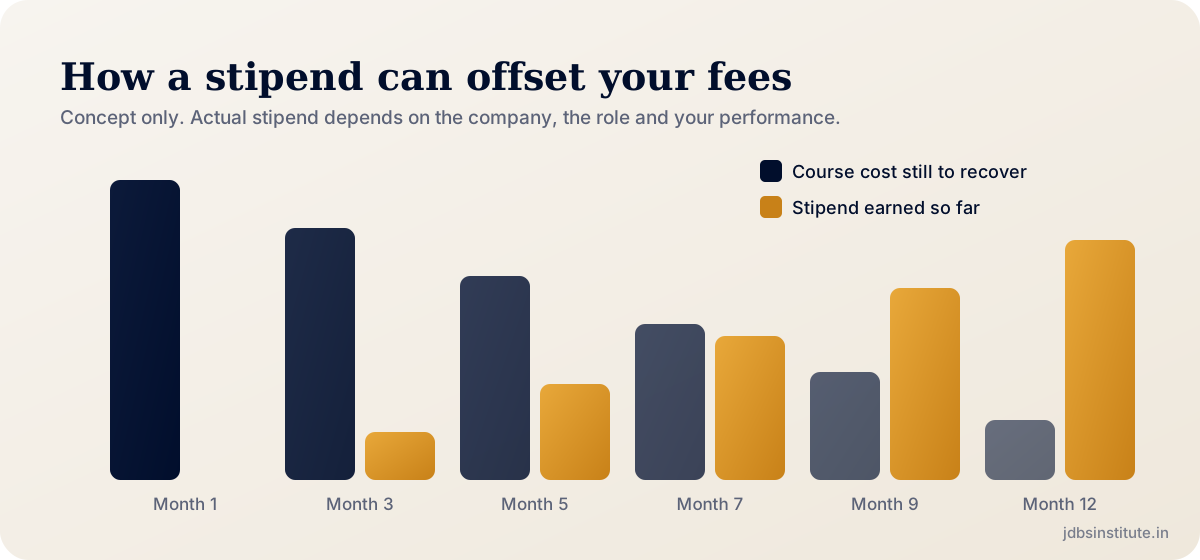
And third, quietly, it changes how you see yourself. You're not "just a student" anymore. You're someone who gets paid for their work.
Paid internship vs unpaid internship
Unpaid internships aren't always bad. Some big organisations offer them and the name on your resume is worth it. But for most freshers in Kanpur, an unpaid internship in a small office often means making tea and photocopies for two months.
Paid ones tend to come with more structure, because the company has something invested in you. That's not a law of nature, just a pattern we've noticed over years of placing students.
How to judge the internship once you've started
Picking a program is half the job. The other half is making the internship count once you're in. A few things we tell every student before their first day.
Treat it like a job, not a class. Turn up early, dress the way your supervisor dresses, and keep your phone in your pocket. Ask questions, but write the answers down so you don't ask the same thing twice. Keep a small notebook of what you did each week. That notebook becomes your resume later, and it's far easier than trying to remember everything six months on.
And if something feels off, like you're not being taught anything or the work has nothing to do with your program, say so early. A good institute wants to know.
How we do it at JDBS
Quick summary, since you've been patient. Eligible candidates start paid practical training in companies from the first month. You keep training alongside work. You get professional grooming, resume building and interview preparation. Placement assistance continues through the course, and eligible candidates receive a Job Guarantee Card* (conditions apply, listed on our terms page).
Our programs run from 3 month fast-track courses to 1, 2 and 3 year diplomas. More on the philosophy behind it on our About page.
A quick note for parents
If you're a parent reading this, your instinct to be cautious is right. Come along for the counselling session, ask for everything in writing, and ask about the safety and timing of the workplace your child will join. Any genuine institute will welcome those questions. We certainly do.
Before you decide
Take this checklist with you wherever you go, including to us. Ask every question. Write the answers down. Compare. If you'd like to start with us, you can visit the Govind Nagar office, call 6386475973, or apply online and we'll get in touch. We'll answer every one of those five questions without dodging.