"Sir, what do I write? I have no experience."
We hear this almost every week, usually from a student holding a resume that's mostly blank space and a long list of hobbies. Reading. Listening to music. Travelling.
Here's the thing. You probably have more to say than you think. You just haven't been shown how to say it. A fresher resume isn't judged the way a manager's resume is. Nobody expects five years of work. They're looking for signs that you'll be easy to train, reliable, and able to communicate.
Let's build one properly.
What recruiters actually look for in a fresher resume
We talk to HR people from companies across Kanpur regularly, and their wish list for freshers is short. Can this person communicate clearly? Have they done anything practical? Do they look like they'll turn up on time and take instructions?
That's mostly it. They're not hunting for a perfect percentage. A recruiter flicking through a pile of 80 resumes for one opening is looking for a reason to say yes, or a quick reason to say no. Spelling mistakes, a messy layout and vague lines like "hardworking and dedicated" are quick reasons to say no.

The one-page fresher resume layout
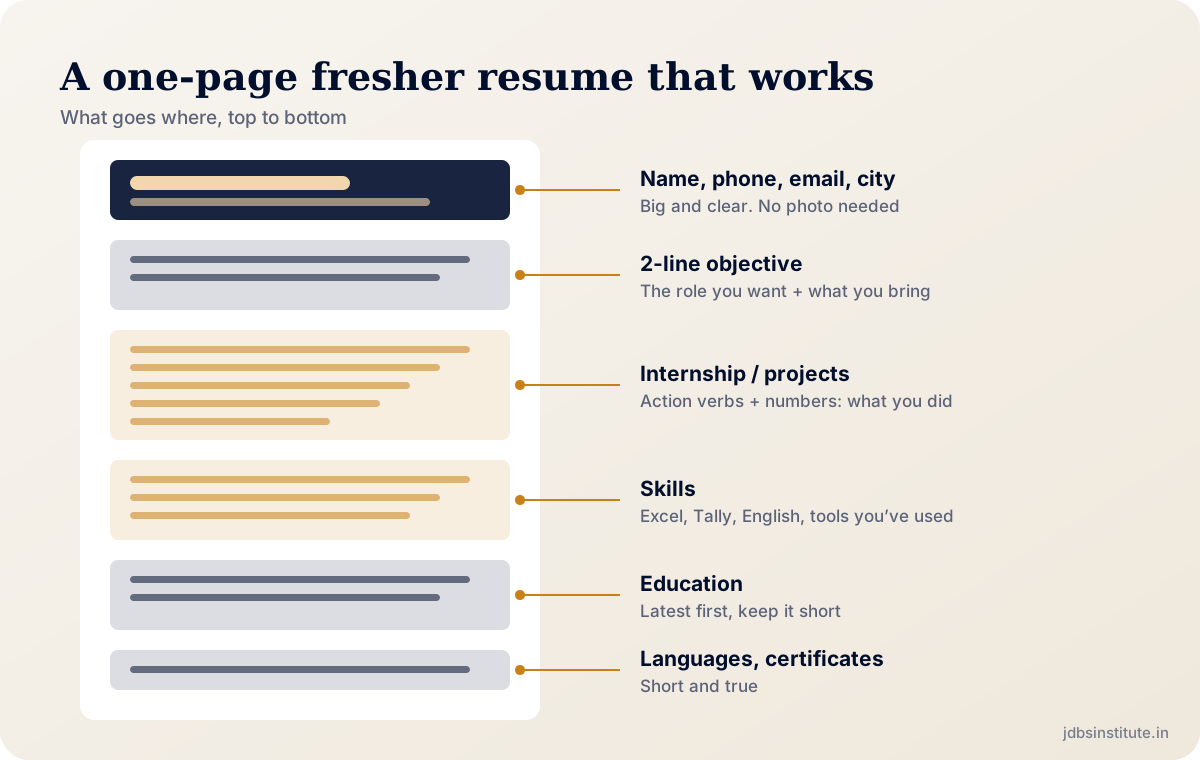
Keep it to one page. Use one clean font, consistent spacing, and clear headings. Here's the order we recommend for most freshers:
- Name and contact details at the top: phone, email, city. Use a sensible email address (your name, not coolboy_007).
- A two-line summary that says what role you want and what you bring.
- Education, latest first.
- Projects, internship or practical training. This is the section that does the heavy lifting.
- Skills, specific ones.
- Certifications and achievements, if you have any.
- Languages you speak and write.
Hobbies are optional. If you include them, make them specific and short. "Captained my school kabaddi team" says something. "Reading" doesn't.
Turning "nothing" into a strong experience section
This is where most freshers give up, so let's slow down.
Rename the section. "Work Experience" makes you feel like you're failing. "Projects & Practical Training" or "Internship" lets you include things you've actually done:
- a college project or presentation
- helping in a family shop or business
- volunteering at an NGO, a temple committee, a school event
- part-time tuition you gave to younger kids
- any paid training or internship
Then, for each one, write what you did and what changed. That second part is what most people skip.
Here's an example of the same experience written two ways:
| Before | After |
|---|---|
| Helped in my father's shop. | Managed billing and stock entries at a family hardware shop for 8 months; set up a simple Excel sheet that cut month-end stock counting from two days to one. |
| Did internship at a company. | Completed paid practical training in the HR department of a manufacturing company; maintained attendance records for 60+ workers and handled joining paperwork for new hires. |
| Made a project on marketing. | Surveyed 40 local shopkeepers in Kidwai Nagar on how they use WhatsApp for orders; presented findings to class and faculty. |
See the difference? The "after" column has a task, a scale, and a result. You don't need huge numbers. Small, honest specifics beat big vague claims every time.
Skills: be specific or leave it out
"Computer knowledge" means nothing. "MS Excel (VLOOKUP, pivot tables), typing at 35 wpm, Tally basics" means something.
Same with soft skills. Instead of listing "communication skills," show it elsewhere: a project where you presented, a role where you dealt with customers. Recruiters trust evidence more than adjectives.
Only list skills you can demonstrate if asked. If an interviewer says "show me VLOOKUP" and you freeze, the whole resume loses credibility.
Common fresher resume mistakes we keep seeing
Copying a template from the internet and forgetting to delete the placeholder text. (Yes, really. "Lorem ipsum" has appeared in interviews we've prepped for.)
Writing a career objective that's all about you: "To get a challenging position in a reputed organisation where I can grow." Every resume says this. Swap it for one or two lines about what you can do for them.
Listing every exam since Class 5. Keep it to 10th, 12th and anything after.
Using three fonts, two colours and a photo in sunglasses. Keep it boring and clean. Boring is good here.
Not tailoring it. If you're applying for a sales role, your customer-facing experience goes on top. If it's an admin role, lead with organising and records.
Why practical experience fixes the resume problem
There's only so much you can do with formatting. At some point, the strongest resume is one with real work on it.
That's part of why we built JDBS Institute around a Work-Integrated Learning Model. From the first month, eligible students are placed in companies for paid practical training, so they earn a monthly stipend and, just as important, collect real lines for their resume. By the end of a program, "no experience" is no longer true.
Resume building, interview preparation and placement assistance are included in every program. We've written about the bigger idea in how learn-while-you-earn works in Kanpur, and if your resume is getting you interviews but not offers, our first job interview prep checklist is the next thing to read. For a sense of what employers actually test, see the skills industrial companies want in freshers.
Your resume is a first draft. That's fine.
Nobody gets it perfect the first time. Write a version today, show it to someone who'll be honest, and fix it. Then fix it again after your first interview, because you'll learn what questions come up.
If you'd like help, bring your resume to our Govind Nagar office or call 7081107037. And if you want real experience to put on it, you can apply here or read more about how our programs work.